Showing posts with label Skankaway 2011. Show all posts

MRolla Transmission Lessons

Transmission configuration is surely the most interesting and debated issue of the twin engine MRolla. We considered several configurations, feasible and not, but opted for what we felt would be the simplest to drive, most reliable on track, and easiest to build.

First we considered possible combinations of manual and automatic transmissions. We were initially drawn to two manual transmissions, as are most people with opinions on the MRolla, but just under the surface of a seemingly simple concept lurk highly technical problems in control linkages and synchronization. Even if we had time, I'm not convinced there would be a racing-reliable way to execute dual manuals.

Two automatics would be easiest to execute, but was too... automatic for our tastes. With the lessons learned from the MRolla this far, I think dual automatics are quite feasible for endurance racing.

We chose to use one manual and one automatic transmission to simplify control and execution. We didn't really care which end had what, but Paul observed we could use the Corolla's pedals unmodified if we put the automatic on the rear MR2 engine. We like simple. Throttle cables for both engines are attached to the original Corolla pedal, allowing us to put the rear engine in drive and ignore it (until we need reverse), then drive "normally" using the Corolla's original controls. This has been successful on track for three endurance races so far.
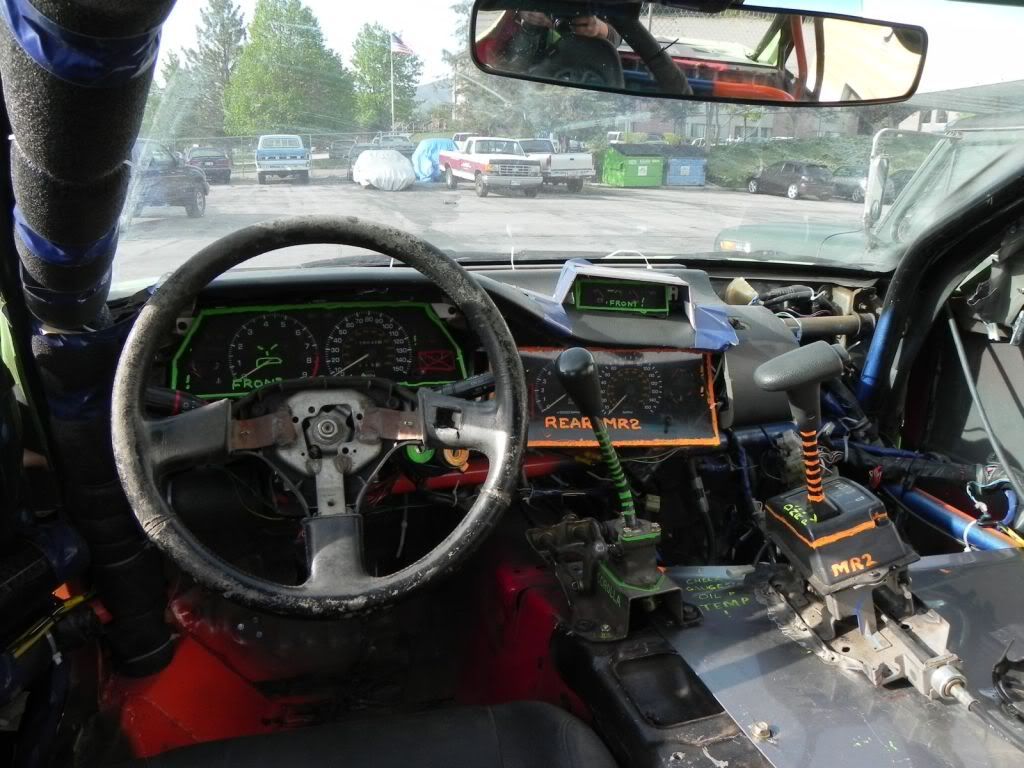
Here you can see the dual transmission
controls and instrument clusters.
First problem: Many drivers shift by sound intuitively. That doesn't quite work with the MRolla because the rear engine with the automatic has a louder exhaust than the front manual. This situation quickly reveals the danger of the rear engine pushing the front engine past red-line to detonation. Our solution is a shift light on the front engine. There is a short learning curve of a few laps before drivers get used to dismissing engine sounds and watching the shift light.

The picture is a little abstract
but this is the top of the
throttle pedal with both
throttle cables attached.
Next problem is controlling the automatic. Ours is a fairly simple automatic from an 1990ish Geo Prizm (Corolla), no fancy-schmancy computer control, but it has several potentially complex factors affecting it's shifting: Engine speed, axle speed, kick-down cable, electronics, overdrive switch, and the shift lever. Much to consider.

We figured out a way to electronically shift the automatic using multi-position switches, but didn't execute it. I envisioned a twist knob to shift the automatic, on top of the manual shift lever, so the driver could control both transmissions with one hand concurrently. Not only do I think this is feasible, but would top coolness charts. But meh... We found a quicker solution and so far: "Ain't borked. Don't fix".

We assumed manually controlling the automatic shift lever while operating the front transmission would be too complex and confusing, but it didn't take long for some drivers to start grabbing lower gears in the rear on certain hills and corners. Manually shifting automatic transmissions actually seems pretty feasible now. Since we wanted to simplify driving as much as possible, and maximize reliability of the rear engine and automatic transmission, we leave it in "D" by policy.
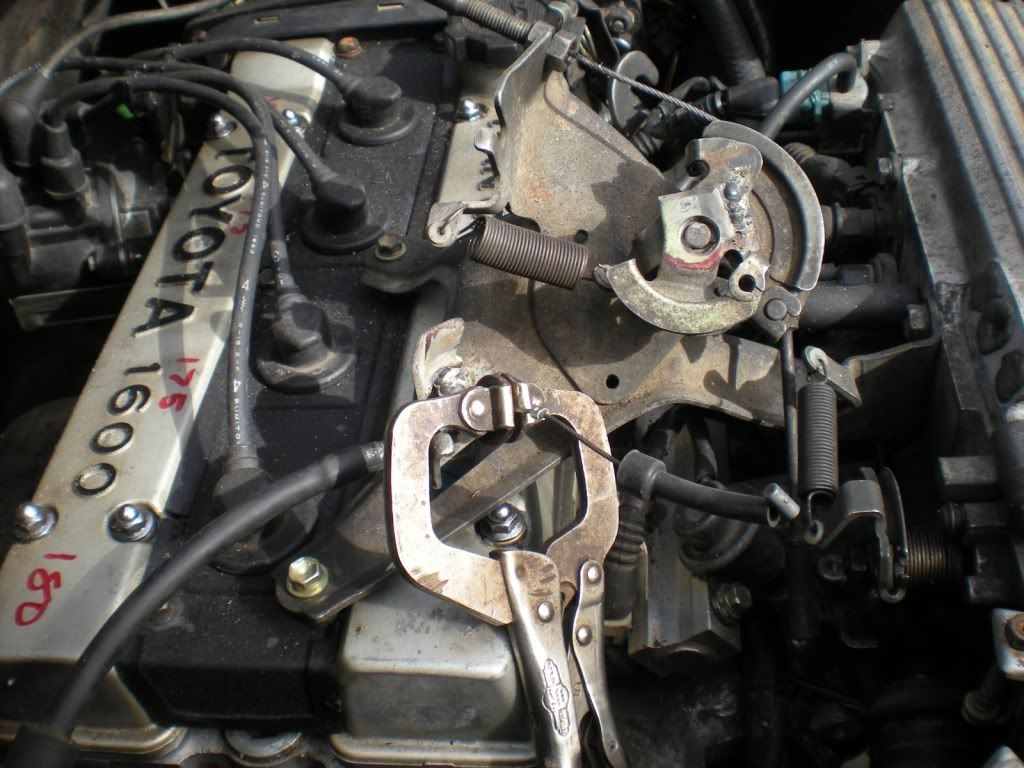
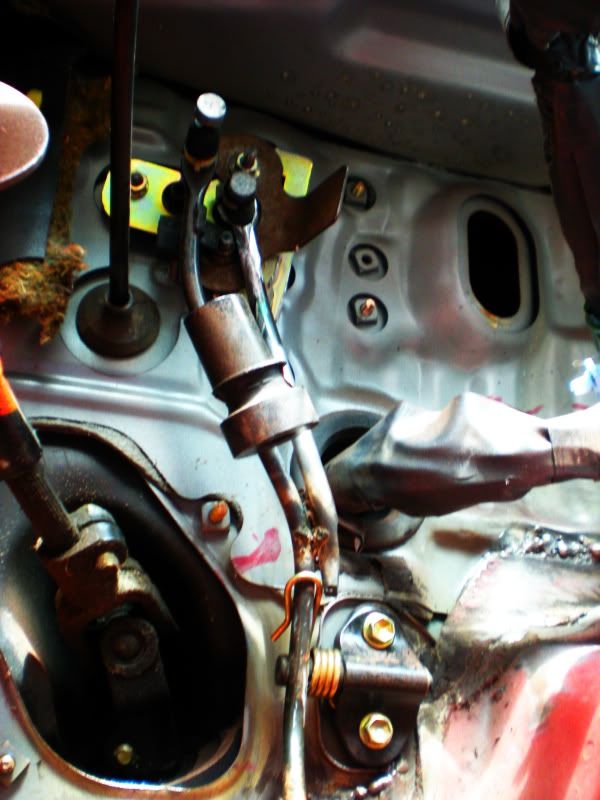
Here the kick-down cable is simply
extended a few cm and clamped
in position.
For the MRolla's first race we stumbled upon a fortunate set up. Our engine, originally with a manual transmission, didn't have a linkage to connect the "kick-down" cable to the throttle. What's a kick-down cable? You know how you can romp on the gas in an automatic car and it will down-shift and operate at higher RPMs until you ease up? The kick-down linkage basically informs the transmission when driver is standing on the gas. Since we ran out of production time to link this mechanism to the throttle, we just left it disconnected. During initial test laps we observed the shift point was an extremely low RPM, and we could get no power without manually operating the control lever. So we pulled the kick-down cable out a bit and clamped it in position. That gave us a happy 5500 RPM shift point, and the clamp stayed for two races.


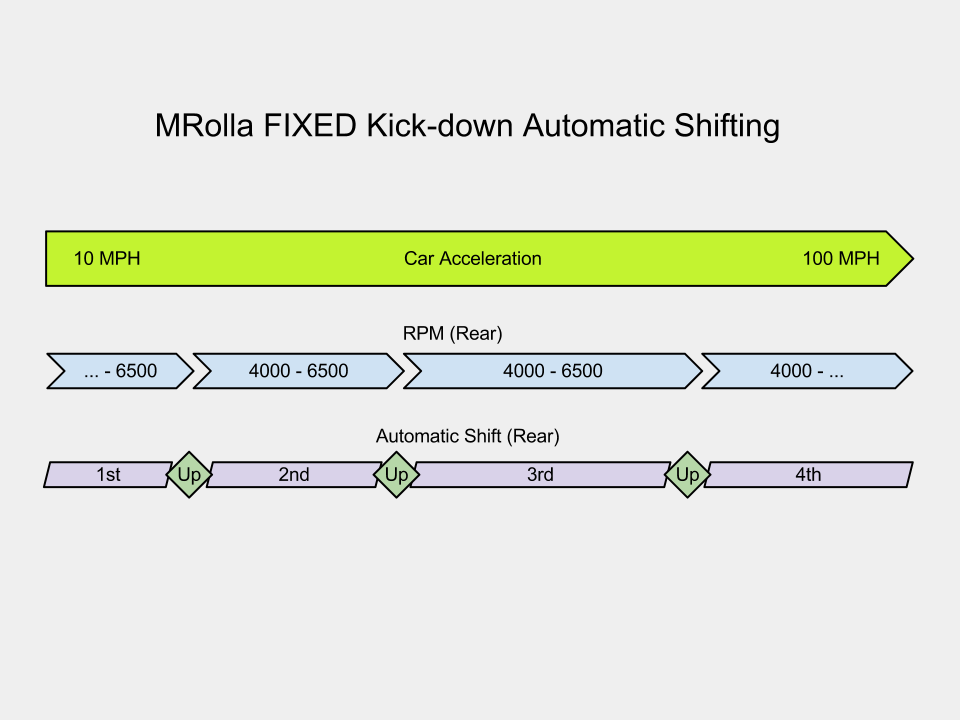
This is not really directional. Shift points are the same
whether increasing or decreasing speed.

Above we see that with the kick-down cable fixed in position, automatic shifting is a simple, nearly direct function of the speed of the car. Whatever may be happening with the throttle pedal or the other engine and transmission, the rear transmission keeps it's gear selection until it hits the shift RPMs. Deceleration works the same way. For racing this automatic shifting is nearly as intuitive as manual, since you generally want to shift at a peak RPM to maximize power.

Here you see the throttle cable
above, and kick-down cable below,
are linked.
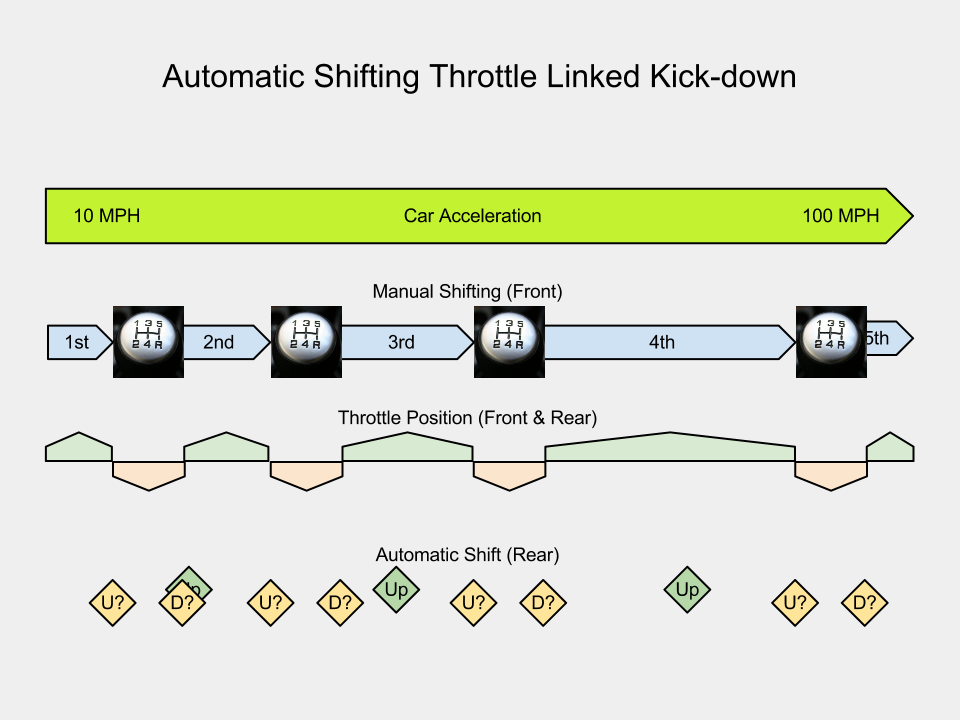
For our third race we tried to improve our automatic control and played quite a bit with the kick-down linkage during test/tune. We hoped we could vary shifting according to throttle pedal position like a normal automatic, giving harder acceleration out of corners, and allowing the engine to rest during low speed situations like yellow flags. We linked the kick-down and throttle cables and put a few drivers through the course. It worked, but it sucked. The transmission varied shift RPMs relative to throttle position, as planned, but as illustrated below, this gave the automatic schizophrenia.
Note the automatic transmission initiates 11 shifts
compared to 3 with a fixed kick-down cable.
Shift initiation (represented by diamonds on the bottom row) was now a function of car speed plus CHANGE in throttle position. For each manual shift of the front engine, the driver releases then engages the accelerator, causing the rear automatic to disengage and initiate shifts twice. The normal automatic shift points due to acceleration are also in the mix. The automatic didn't have time complete many of these extra shifts before throttle pedal changed its mind again. The results on track were frequent, incomplete, hard, clunky, and unnecessary shifts, especially entering and exiting corners.

For the race we went back to the clamped kick-down cable, but at maximum pull. This pushed the shift point to about 6300 RPM. This high rear shift point had an unexpected affect: It put an unbalanced work load on the rear engine. Shifting the front, healthier engine was happening at 6000 RPM, or lower under relaxed conditions. Situations like coasting down The Carousel, we were idling the front engine, but flogging the rear engine. That engine had been past due for catastrophic failure since we first welded a cage into the original V-RAM MR2, and had a long racing career of repeated over-heating since then. We ended up blowing the head gasket.
Finishing the race on a blown engine.
Thanks to Judy Kiel for the photo.
So we killed an engine in the learning process, but have a pretty refined, effective configuration now. For the upcoming Infineon race we'll have the fixed position kick-down cable, targeting about 5700 RPM or less.

October 2011 Mayhem

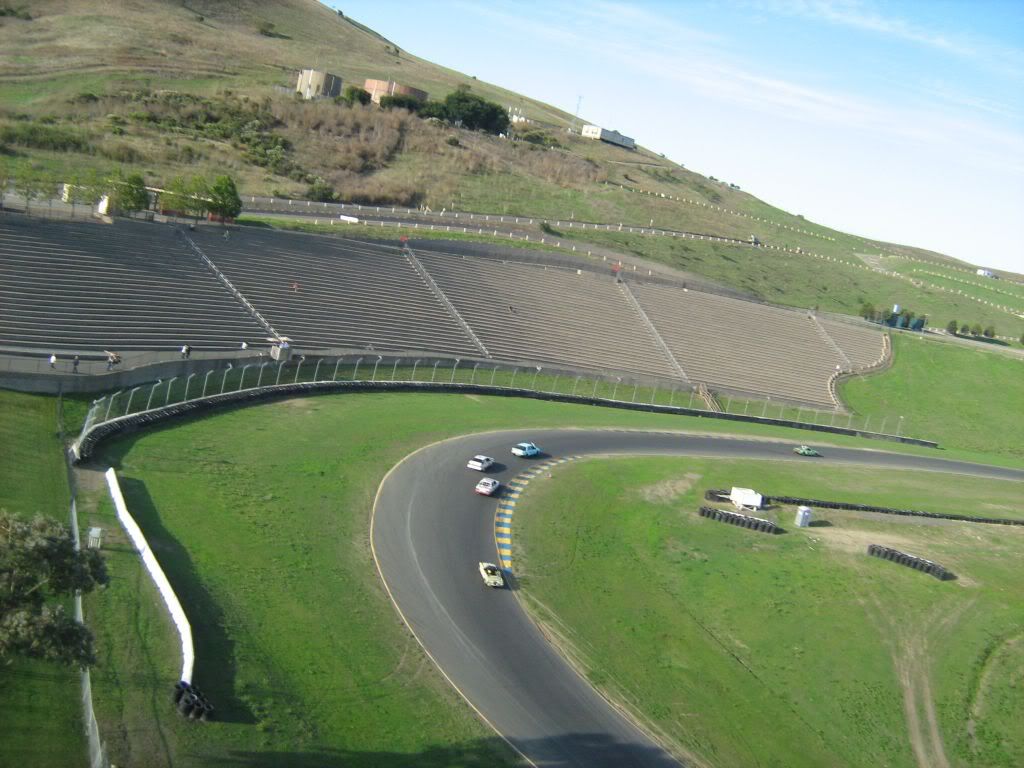
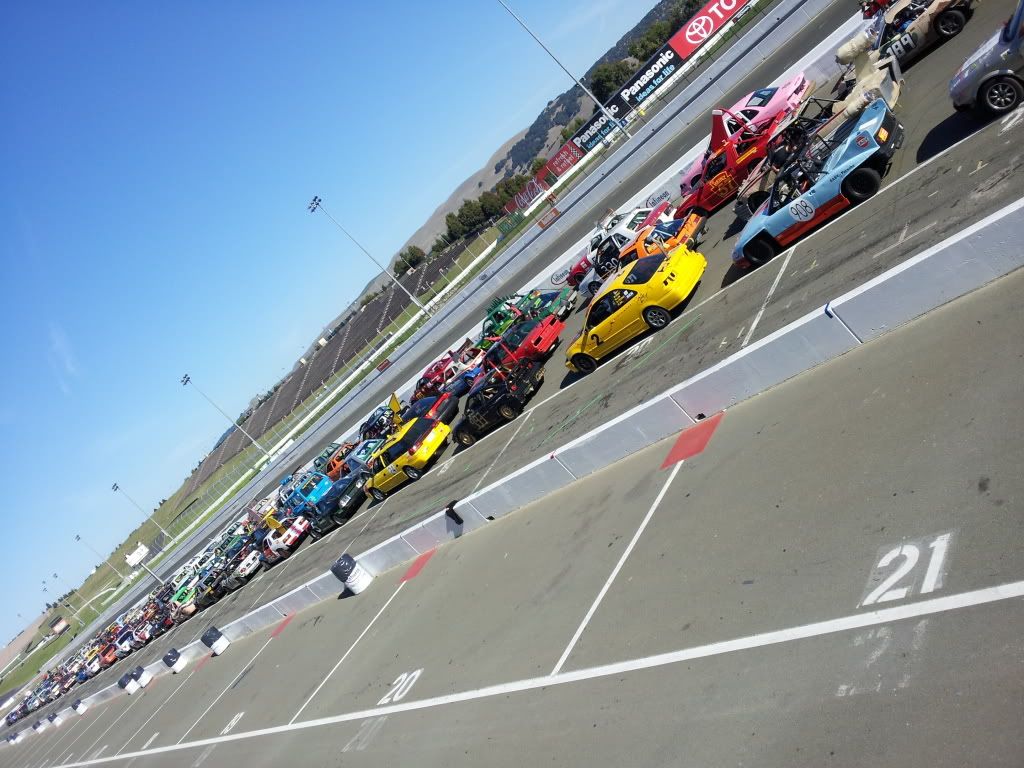
Test day aerial photo with what I think is the MRolla on
the right. (Thanks to MurileeMartin.com for the photo.)
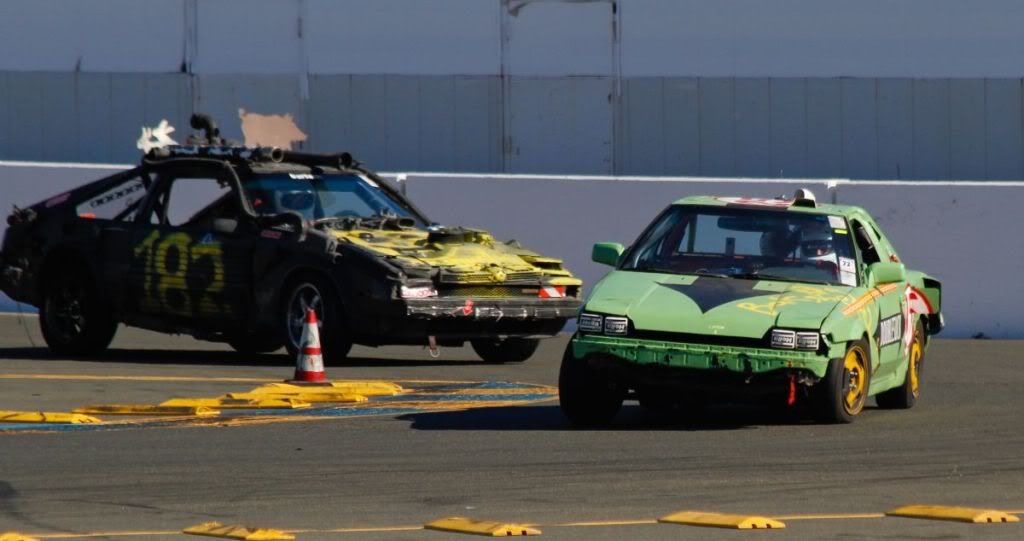
The October 2011 Infineon 24 Hours Of Lemons event was one of the craziest I’ve raced since Altamont days. 165 cars of questionable qualifications on track, more generous than usual flagging practices, and some intense competition combined for some spectacular action. The forums have be aflutter with debates regarding safety and sanity levels. Personally I was a bit surprised by some drivers failing to ease up for a dead Camaro mid track with cautions flags flying, resulting in a fairly catastrophic rear end collision.


Also, one of the most spectacular roll-overs I’ve seen at lemons, 5.5x rolls, also occurred.


Before the race. (Thanks to
MurileeMartin.com for the photo.)
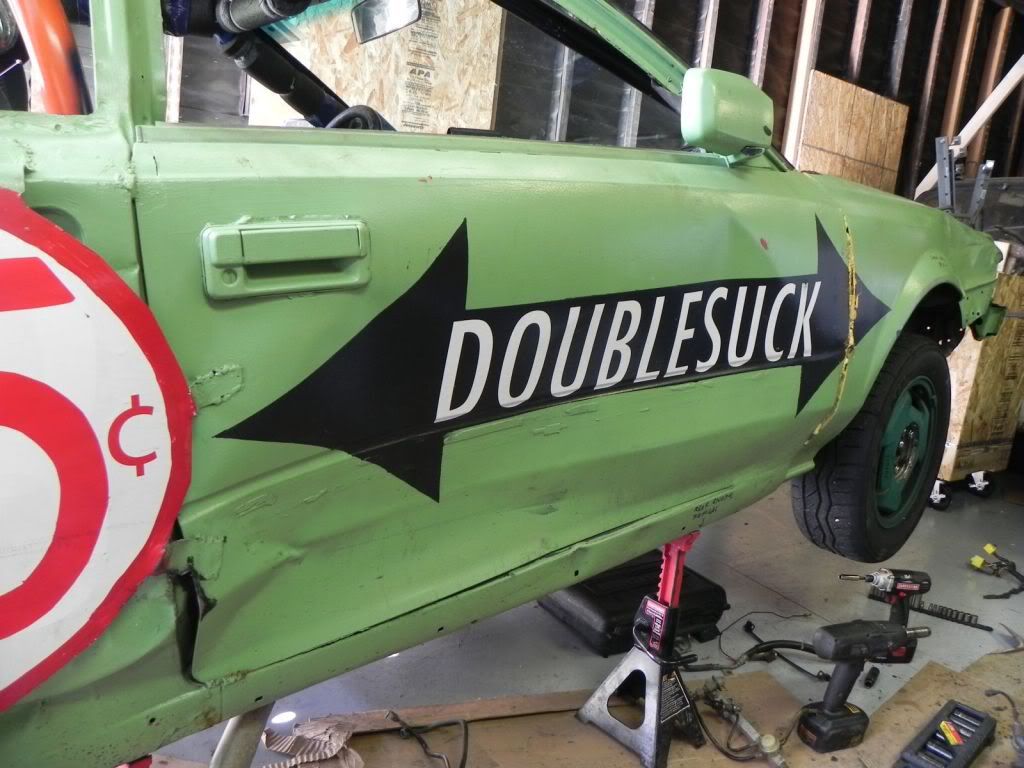
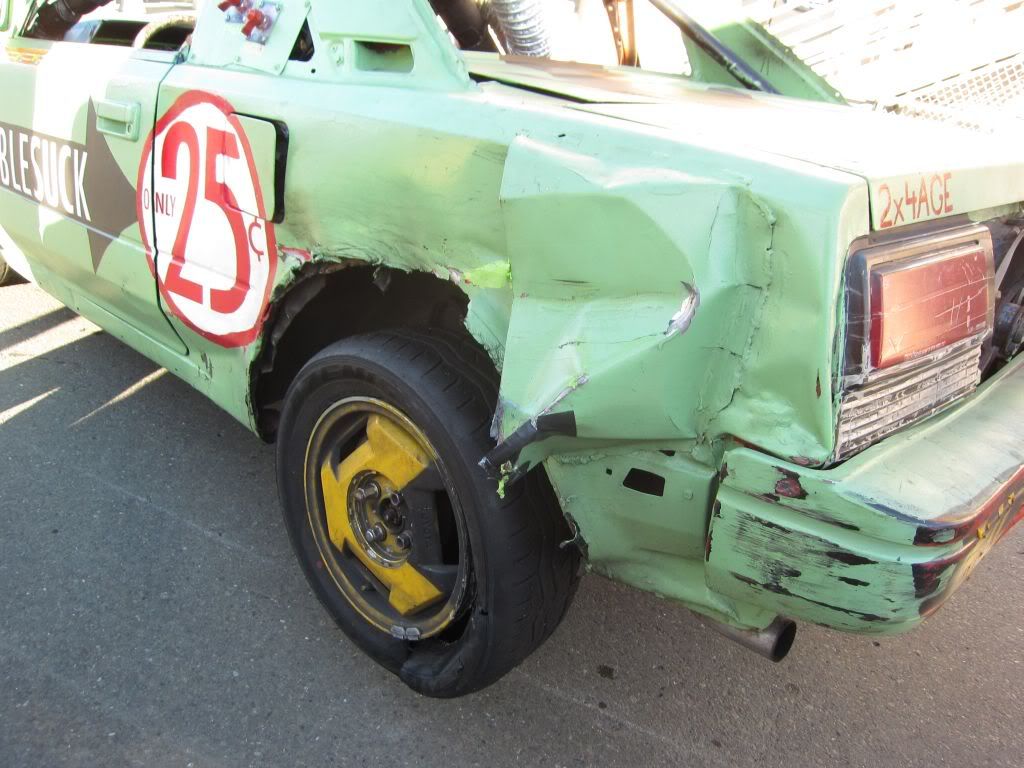
We finished uninjured, but did suffer two notable collisions. I've been scrounging for some better pics of the damage we took at Infineon and found a couple shots over at www.murileemartin.com that have finally made this post possible. One was a pretty good t-bone from a CRX. We got this very apologetic email after the race:

After the race (Thanks
to CRX #3 for the bash.) 
“I'm a rookie driver on a rookie team and I just wanted to apologize for making contact with you at Sears Point this past weekend. We had the blue CRX #3. I kept my nose clean the whole race and then with about 15 minutes to go I tried to make an inside pass on the DoubleSuck in turn 9a and our racing lines collided and I caught you in the side. Not sure what happened to you but I spun out because I had my wheels cranked to try to get off you. Took myself to the penalty box, got back out with 8 minutes to go and ran out of gas. It was our teams only contact of the entire weekend and probably my only risky move of the weekend (I mean, other than racing with 160 other crappy cars.) Anyway, again, my apologies. I hope it didn't mess you up too much.”

I enjoyed his forum post even more:

“Maybe it is because this was my first ever race. Maybe it was because we were in a pretty slow, bone stock, junkyard CRX and I wasn't trying to haul ass through a crowded field but I didn't mind the crowds. I was also trying my durndest to drive as best as I could, get out of the way, stay on a steady line as best as I could, keep an eye on my mirrors and be respectful as a new person . I was terrified I was going to mess someone else up more than anything (I think I only messed up once, right at the end. Sorry Doublesuck.) But as I got more seat time and tried to learn how to pass a little I found the challenge of passing cars and getting passed by cars without pooping myself (especially when the HardEze or MTGT or Punk car would go flying by me) to be a thrill. Since it is my only race it feels like what Lemons should be. Fast cars having to use skill to get through a bunch of slow cars, slow cars having the sense to watch out for those fast cars and still get some racing on. It was just so cool. And I'm a big chicken. Not a daredevil at all. Biggest worry wart on my team. Soft hands. Public radio employee. And I dug it all. Got fast time for my entire team of newbies. You all have been doing it longer and you may be right but from the perspective of this new guy, I was okay with everything the way it was this weekend.”

 (Thanks to MurileeMartin.com for the photo.)
Also, former Volatile RAM teammate Mark Jr came by in the paddock offering beers of restitution. In his PiƱata Porsche 928, he lost the rear end on the tracks tightest turn, got sideways, came back across the track, and clubbed our rear end chewing up the wheel. We were towed off, but after changing the wheel and pulling the fender back out we were able to finish the race. The hub was floppy by the end of the race and we've since replaced it.

Some find it frustrating, but I welcome the high intensity levels of a crowded field, and it's great that comraderie outweighs competition in this series.

More MRolla

Another HUGE field at Infineon, 164 cars. FUN!
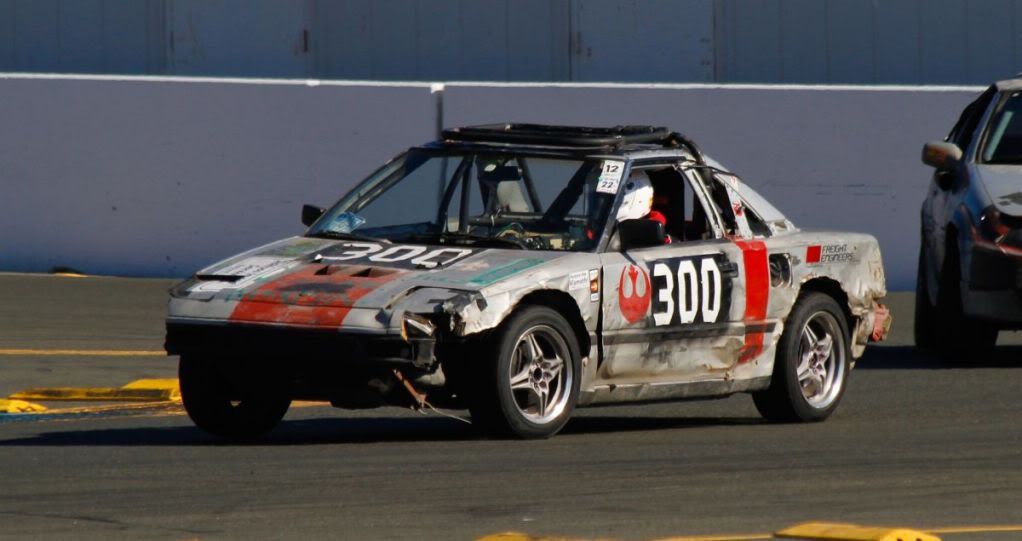
Infineon October 2011: Nutshell version is we blew two rear engines but kept racing on just the front to finish 106 of 164.

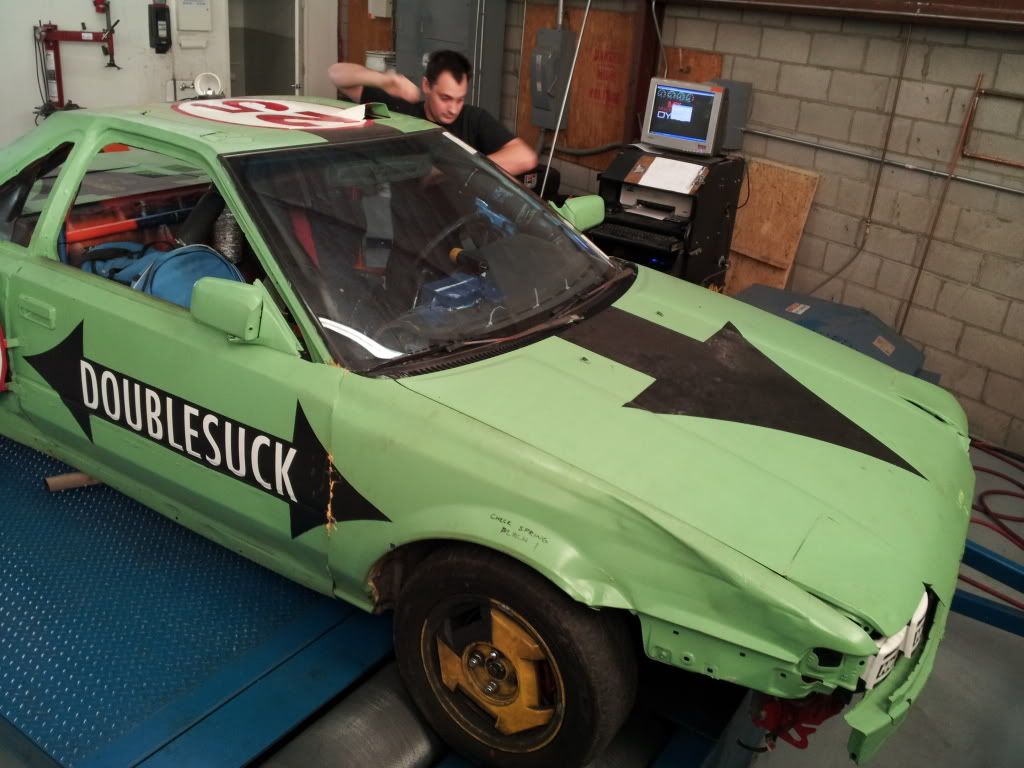
We rolled into California early enough to attend the Evil Genius Racing party on Thursday. Evil John was as interested to see dyno results for the MRolla as we were.
On the dyno at Evil Genius Racing.

Front - 97 HP @ 6500
86 ftlbs @ 5250
Rear - 82 HP @ 6300
71 ftlbs @ 5100
Combined : 179 HP & 157 ftlbs.

We also put it on scales:
2810 pounds.
52% front 48% rear.

Drivers were Paul, Judy, Sparky Pete of Killer Zombee fame, and yours truly.
Thanks to Judy Kiel for this photo.
We had a good test/tune day Friday. Dialed in our alignment. The double springs up front made a huge improvement in body roll.

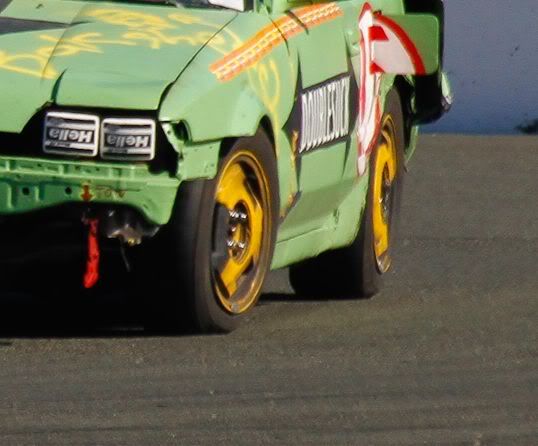
Looking at some photos I think we need to review our tire and pressure decisions. Below is the MRolla rounding the tightest turn on the course on our usual set of 195/50 tires on 14x5.5" stock wheels.
Our friends the Black Flags bearing down. Thanks to Judy Kiel for this photo

Note that the tires look like they are about to rip right off the rims.
Tires look like they are barely hanging on.
Compare to the Snowspeeder's new 205/50 15x6.5" and 15x7" staggered set.

I heart these wheels. Thanks to Judy Kiel for this photo.
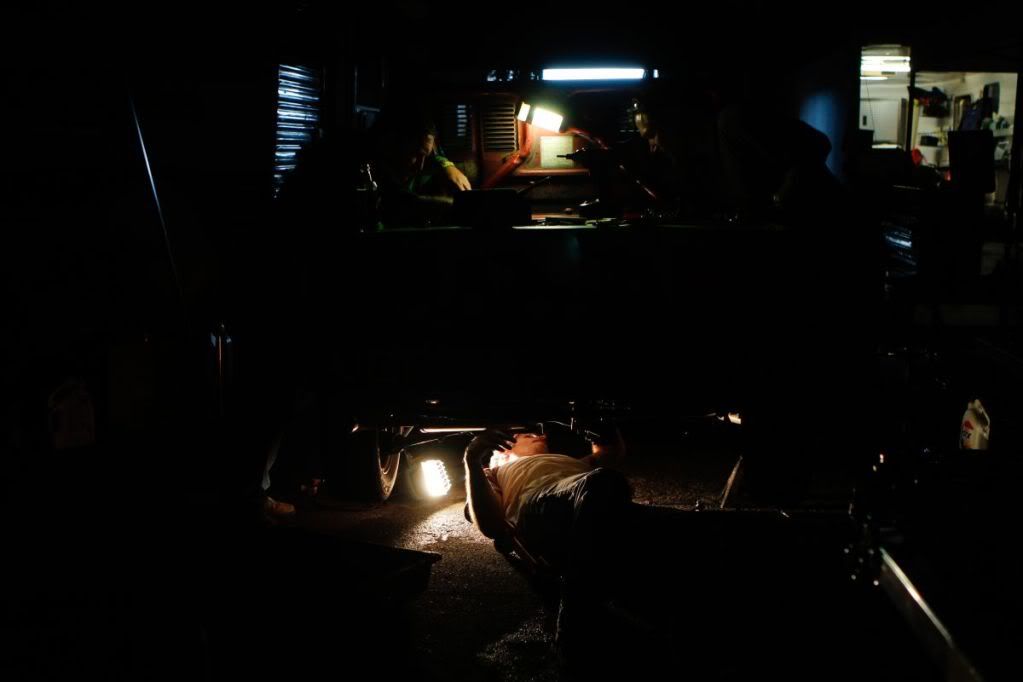
As usual, the MRolla was among the fast cars when it was running on both engines, but we (I) blew a head gasket in the rear. So we disconnected the axles and finished day one on the front engine, swapped the engine overnight, forgot to adapt plumbing for our electric water pump, overheated and trashed the second engine, raced most of day two on the front engine.
Wee hours of engine swap. Thanks to Judy Kiel for this photo.
Paul and I were at the track until 1:30 am doing the swap. The lack of sleep really fatigued us and the next day was exhausting. I literally couldn't keep my eyes open while I was watching the race and Paul ended up doing a good share of my driving.

We did get smashed into by two other cars. I'll try to get some details and pics of the damage posted later. Also I'll post about some of what we learned bout our transmission system.


Overall we still had a ball and enjoyed all the challenges. Learned much about our car and we can't wait to make another run with the MRolla.

MRolla Once More This Year

Tragically, Paul's latest project car for Stick Figure Racing has been deemed too lemony for even the October 24 Hours Of Lemons at Infineon by Jay and Evil John. We're touched
that they care more about our safety than we do.

Thus we've rolled the MRolla into Paul's garage and started sorting out the issues that haunted it at Reno and Denver. Body roll and the mysterious fuel cut-off problem are getting attention. We also changed the way the automatic transmission in the rear is linked to the throttle. Initial driveway drag-strip tests indicate the MRolla now launches rather than accelerates.

We fabbed up some very fitting front springs, Corolla and MR2 coils combined.


In other news, I'm hooking Joe and the Snowspeeder up with these bitchin mags.


Finally, the State of Utah sent me a nasty-gram saying they were going to delete my FX16 from their computer system if I didn't complete inspection and registration this month, effectively flushing my original registration payment. With this motivation I did a little adjusting and tightening and it's now street-legal. Now I'm having a ball, zipping around in this thing, annoying neighbors, diminishing property values, and taking all my corners at tire-squeal speeds. The State of Utah now regrets bugging me to get this out of my yard and on the streets. Rattle-can paint job is in the near future.