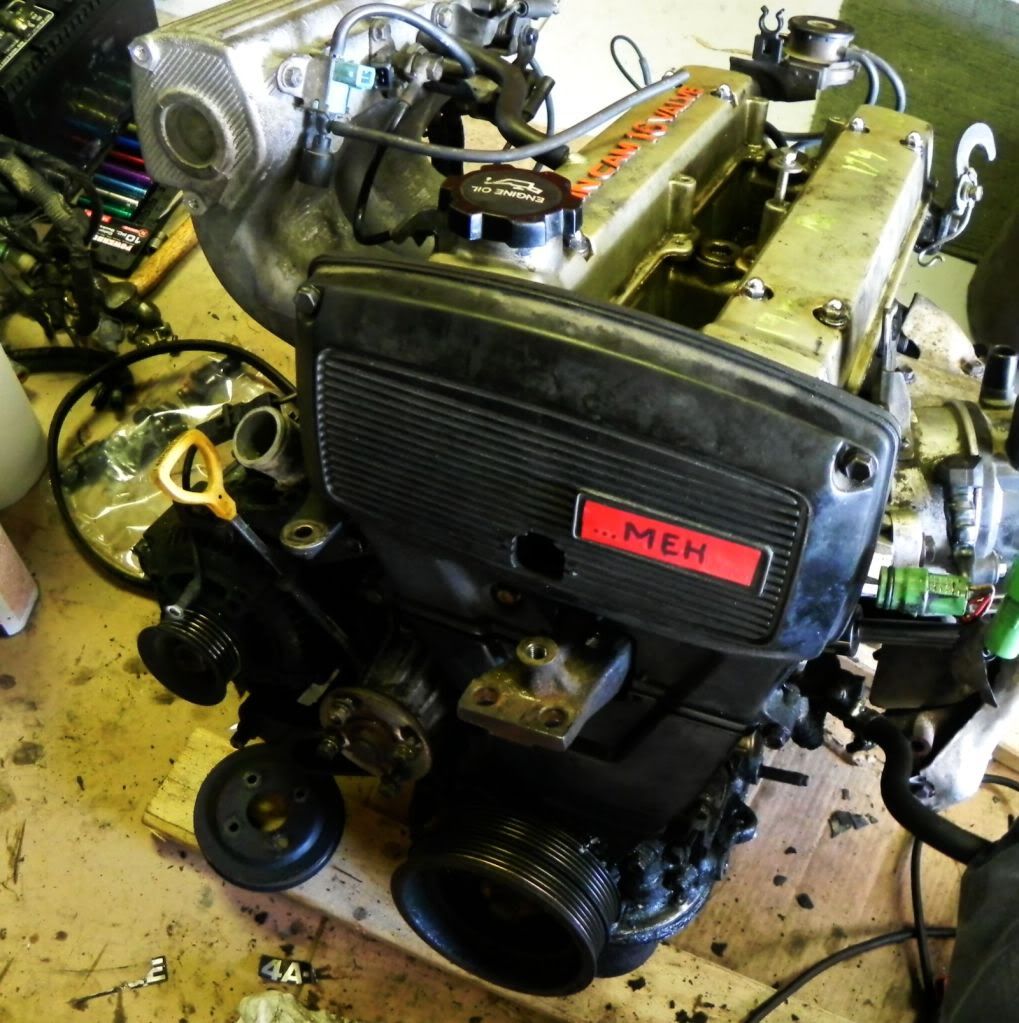
Transmission configuration is surely the most interesting and debated issue of the twin engine MRolla. We considered several configurations, feasible and not, but opted for what we felt would be the simplest to drive, most reliable on track, and easiest to build.
First we considered possible combinations of manual and automatic transmissions. We were initially drawn to two manual transmissions, as are most people with opinions on the MRolla, but just under the surface of a seemingly simple concept lurk highly technical problems in control linkages and synchronization. Even if we had time, I'm not convinced there would be a racing-reliable way to execute dual manuals.
Two automatics would be easiest to execute, but was too... automatic for our tastes. With the lessons learned from the MRolla this far, I think dual automatics are quite feasible for endurance racing.
We chose to use one manual and one automatic transmission to simplify control and execution. We didn't really care which end had what, but Paul observed we could use the Corolla's pedals unmodified if we put the automatic on the rear MR2 engine. We like simple. Throttle cables for both engines are attached to the original Corolla pedal, allowing us to put the rear engine in drive and ignore it (until we need reverse), then drive "normally" using the Corolla's original controls.
This has been successful on track for three endurance races so far.
 |
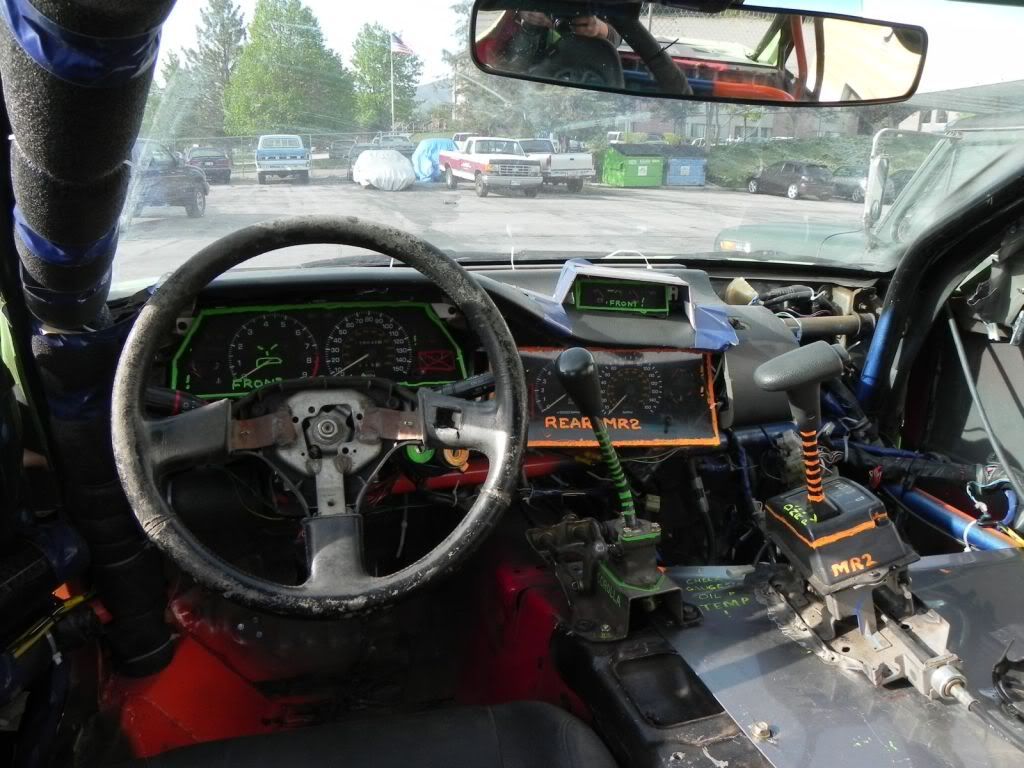
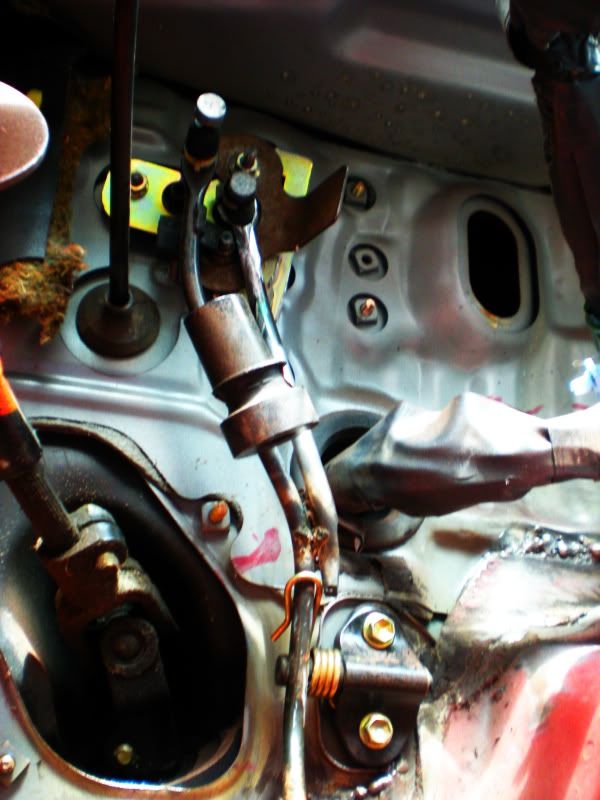
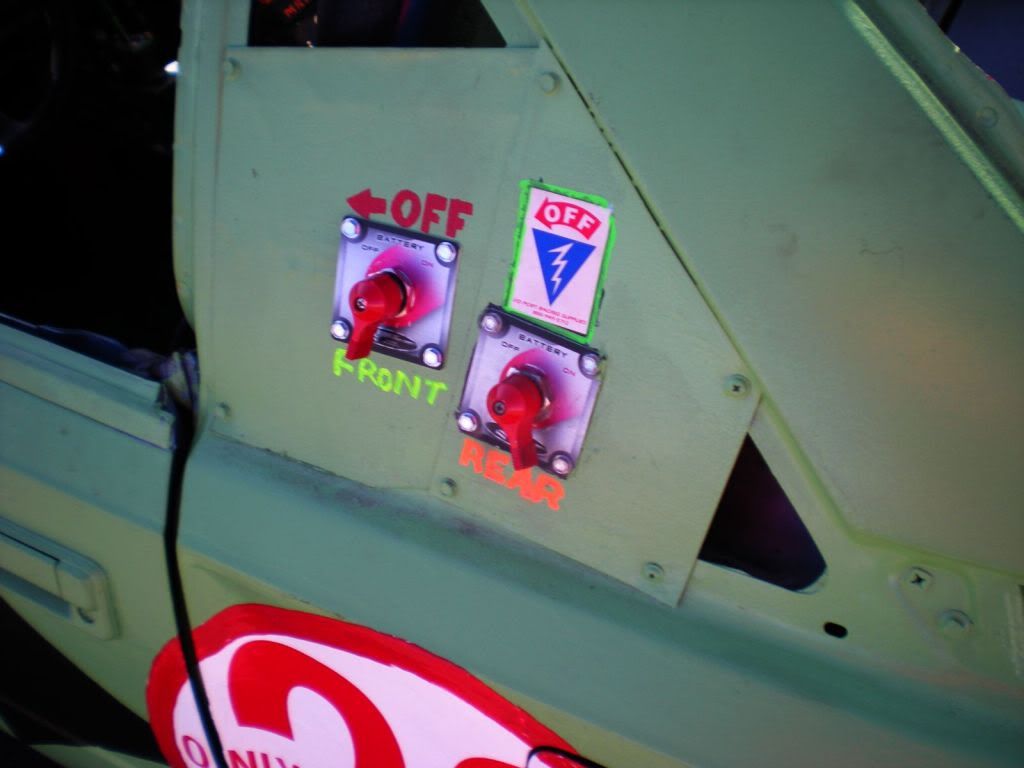
Here you can see the dual transmission
controls and instrument clusters. |
First problem: Many drivers shift by sound intuitively. That doesn't quite work with the MRolla because the rear engine with the automatic has a louder exhaust than the front manual. This situation quickly reveals the danger of the rear engine pushing the front engine past red-line to detonation. Our solution is a shift light on the front engine. There is a short learning curve of a few laps before drivers get used to dismissing engine sounds and watching the shift light.
 |
The picture is a little abstract
but this is the top of the
throttle pedal with both
throttle cables attached. |
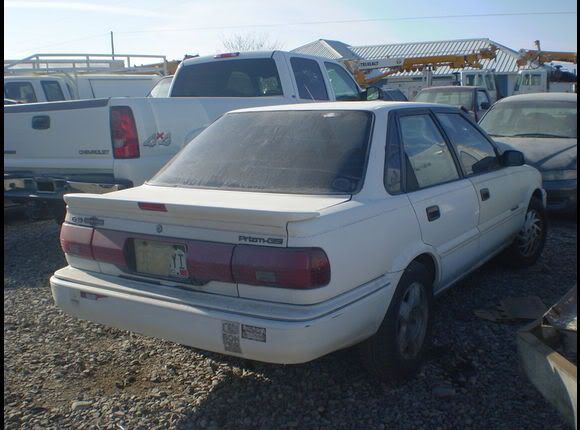
Next problem is controlling the automatic. Ours is a fairly simple automatic from an 1990ish Geo Prizm (Corolla), no fancy-schmancy computer control, but it has several potentially complex factors affecting it's shifting: Engine speed, axle speed, kick-down cable, electronics, overdrive switch, and the shift lever. Much to consider.
We figured out a way to electronically shift the automatic using multi-position switches, but didn't execute it. I envisioned a twist knob to shift the automatic, on top of the manual shift lever, so the driver could control both transmissions with one hand concurrently. Not only do I think this is feasible, but would top coolness charts. But meh... We found a quicker solution and so far: "Ain't borked. Don't fix".
We assumed manually controlling the automatic shift lever while operating the front transmission would be too complex and confusing, but it didn't take long for some drivers to start grabbing lower gears in the rear on certain hills and corners. Manually shifting automatic transmissions actually seems pretty feasible now. Since we wanted to simplify driving as much as possible, and maximize reliability of the rear engine and automatic transmission, we leave it in "D" by policy.
 |
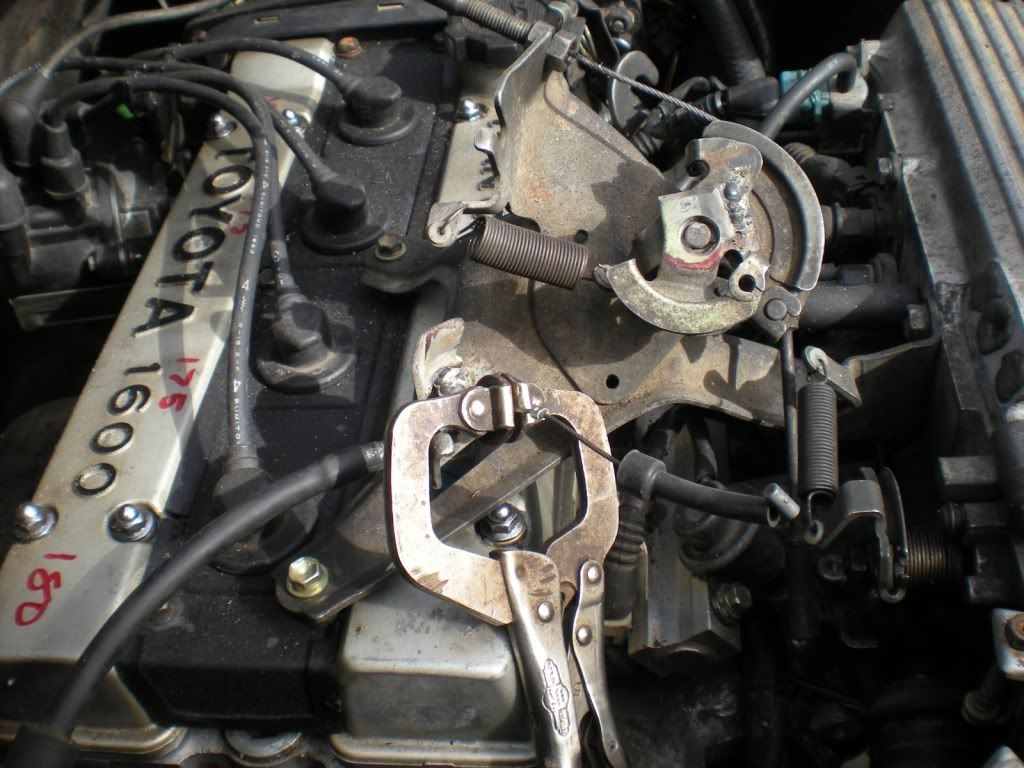
Here the kick-down cable is simply
extended a few cm and clamped
in position. |
For the MRolla's first race we stumbled upon a fortunate set up. Our engine, originally with a manual transmission, didn't have a linkage to connect the "kick-down" cable to the throttle. What's a kick-down cable? You know how you can romp on the gas in an automatic car and it will down-shift and operate at higher RPMs until you ease up? The kick-down linkage basically informs the transmission when driver is standing on the gas. Since we ran out of production time to link this mechanism to the throttle, we just left it disconnected. During initial test laps we observed the shift point was an extremely low RPM, and we could get no power without manually operating the control lever. So we pulled the kick-down cable out a bit and clamped it in position. That gave us a happy 5500 RPM shift point, and the clamp stayed for two races.
 |
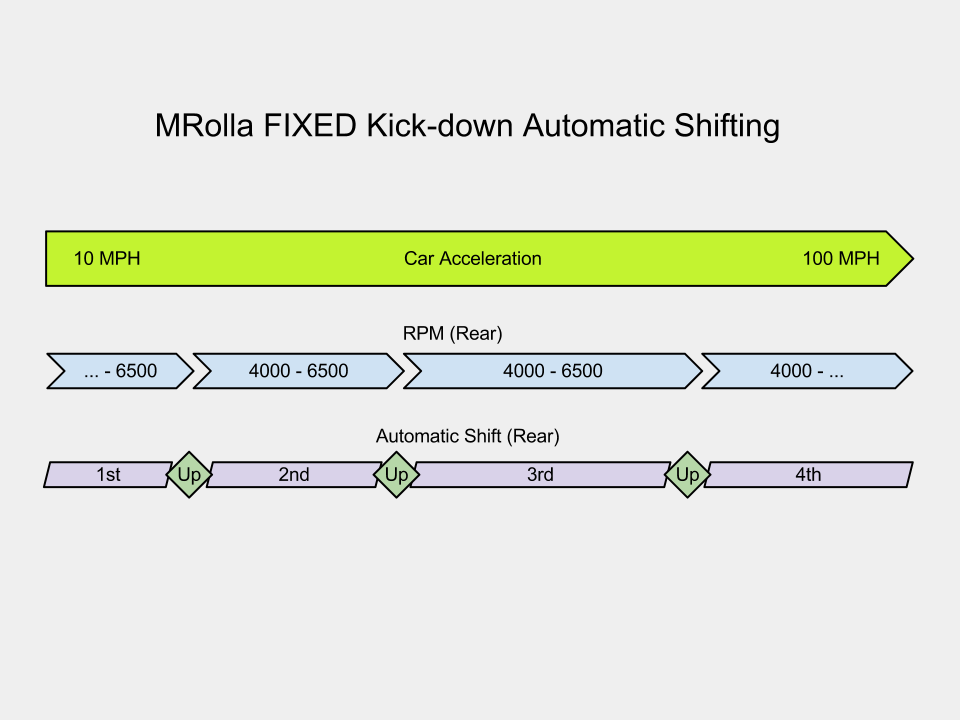
This is not really directional. Shift points are the same
whether increasing or decreasing speed. |
Above we see that with the kick-down cable fixed in
position, automatic shifting is a simple, nearly direct function of the speed
of the car. Whatever may be happening with the throttle pedal or the other
engine and transmission, the rear transmission keeps it's gear selection until
it hits the shift RPMs. Deceleration works the same way. For racing this automatic shifting is nearly as intuitive as manual, since you generally want to shift at a peak RPM to maximize power.
 |
Here you see the throttle cable
above, and kick-down cable below,
are linked. |
For our third race we tried to improve our automatic control and played quite a bit with the kick-down linkage during test/tune.
We hoped we could vary shifting according to throttle pedal position like a
normal automatic, giving harder acceleration out of corners, and allowing the engine to rest during low speed situations like yellow flags. We linked the kick-down and throttle cables and put a few
drivers through the course. It worked, but it sucked. The transmission varied shift
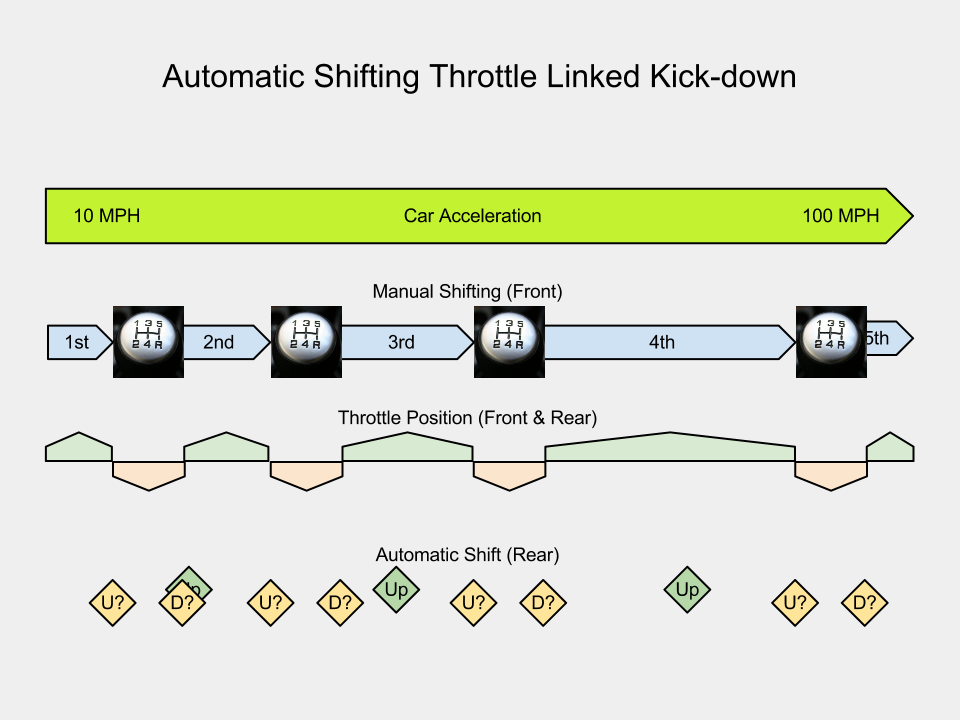
RPMs relative to throttle position, as planned, but as illustrated below, this gave the
automatic schizophrenia.
 |
Note the automatic transmission initiates 11 shifts
compared to 3 with a fixed kick-down cable. |
Shift initiation (represented by diamonds on the bottom row) was now a function of car speed plus CHANGE in throttle position. For each manual shift of the front engine, the driver releases then engages the accelerator, causing the rear
automatic to disengage and initiate shifts twice. The normal automatic shift points due to acceleration are also in the mix. The automatic didn't have time complete many of these extra shifts before throttle pedal changed its
mind again. The results on track were frequent, incomplete, hard, clunky, and unnecessary
shifts, especially entering and exiting corners.
For the race we went back to the clamped kick-down cable, but at maximum pull. This pushed the shift point to about
6300 RPM. This high rear shift point had an unexpected affect: It put an unbalanced work load on the rear engine. Shifting the front, healthier engine was happening at 6000 RPM, or lower under relaxed conditions. Situations like coasting down The Carousel, we were idling the front engine, but flogging the rear engine. That engine had been past due for catastrophic
failure since we first welded a cage into the original V-RAM MR2, and had a long racing career of repeated over-heating since then. We ended up blowing the head gasket.
 |
Finishing the race on a blown engine.
Thanks to Judy Kiel for the photo. |
So we killed an engine in the learning process, but have a pretty refined, effective configuration now. For the upcoming Infineon race we'll have the fixed position kick-down cable,
targeting about 5700 RPM or less.